HomeUncategorizedHow Can Practiko STEM Kits Help Teachers Make Classroom Learning More Practical?
Sep 30, 2026
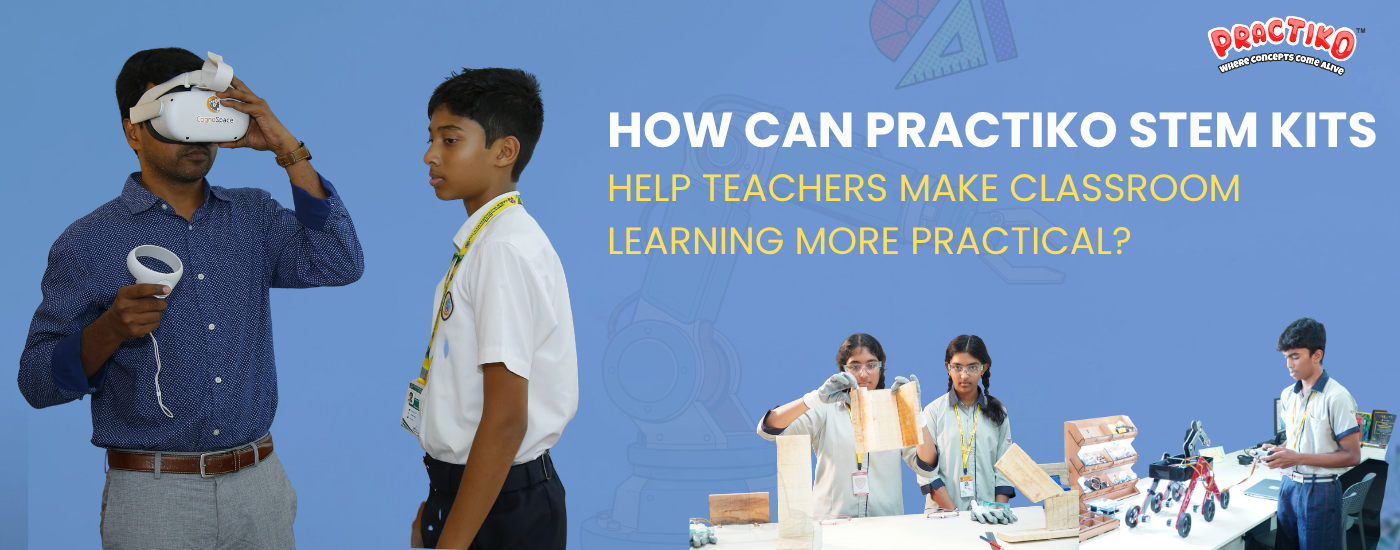
Teaching Science, Mathematics, Robotics, and Engineering concepts is not always easy. Some concepts can be explained through a textbook or a classroom presentation, but students may still struggle to visualize how they work in real life.
This is where stem kits can give teachers another way to teach.
Instead of explaining every concept only through theory, teachers can use practical activities to help students observe, experiment, build, test, and understand. The purpose is not to replace the teacher or the textbook. It is to give teachers better tools to make lessons more interactive.
STEM Kits can become especially useful when teachers receive the right training, instructions, and classroom support. This teacher-first approach is important for schools because the success of any practical learning program depends on how confidently teachers can use it.
Practiko’s learning solution is designed around this idea. 600+ hands-on learning activities across Science, Math, Robotics, and Engineering, along with support for teachers and schools.
Buying educational kits is only the beginning.
A school may have excellent learning materials, but if teachers are unsure about how to use them, when to introduce them, or how to connect them with classroom concepts, the resources may not reach their full potential.
This is why teacher orientation should be an important part of any STEM implementation plan.
Teachers need to understand:
What the kit contains
Which concepts each activity supports
How to conduct the activity
What students are expected to observe
How to divide students into groups
How to encourage questions
How to connect the activity with the syllabus
How to assess student understanding
How to manage the materials after the activity
Practiko’s approach specifically focuses on supporting teachers with tools, resources, and confidence to make lessons engaging and impactful.
One of the biggest advantages of STEM Learning Kits is that they give teachers another method of explaining difficult concepts.
Imagine teaching a topic that students find difficult to visualize.
The teacher can first explain the concept, then introduce an activity, allow students to work with the materials, ask questions about what they observe, and finally connect their observations back to the theory.
This creates a simple learning cycle:
Explain → Explore → Observe → Discuss → Apply
The Practiko classroom model describes a similar shift from listening and memorizing toward exploring, observing, participating, and understanding.For teachers, this means the kit becomes a teaching aid rather than simply another product in the classroom.
Teachers already spend significant time preparing lessons, managing classrooms, assessing students, and adapting explanations for different learners.A practical learning solution should therefore make classroom implementation easier.
Practiko provides activity booklets containing examples, instructions, and assessments. Its learning solution also includes concept video tutorials, app access, tools, materials, and activities.This makes STEM Educational Kits useful as part of a structured teaching process.
Instead of asking teachers to design every practical activity from scratch, the resources can provide a starting point for classroom implementation.The teacher remains the person guiding the learning experience.
Teacher Training for STEM Kits
Teacher training should happen before teachers are expected to conduct activities independently.
Practiko provides virtual teacher onboarding and implementation training designed to help teachers confidently conduct engaging, activity-based classroom sessions.
During orientation, teachers can become familiar with:
1. The Learning Objective
Teachers should first understand what students are expected to learn.
2. The Activity
They should know how the activity works before introducing it to students.
3. The Materials
Teachers need to understand the purpose of each component.
4. The Classroom Process
Teachers should know how students can work individually or in groups.
5. The Discussion
The activity should lead students back to the concept being taught.
6. The Assessment
Teachers can use questions or assessments to check whether students understood the concept.
This approach makes STEM Kits for Schools more than a procurement decision. It becomes a teacher-development and classroom-implementation process.
When schools evaluate STEM kits for teachers, the physical materials should not be the only consideration.
Teachers also need supporting resources.
A useful teaching kit can include:
Activity instructions
Concept explanations
Demonstration videos
Student activities
Assessment resources
Curriculum connections
Digital access
Implementation guidance
Teacher training
Practiko’s provides video tutorials, activity booklets, instructions, assessments, and app access as components of its learning solution.
For teachers, this supporting ecosystem can make it easier to move from preparation to classroom delivery.
Best STEM Kits for Schools: A Teacher's Perspective
When schools search for the best STEM kits for schools, the decision should not be based only on how many components are inside the box.
Teachers may ask more practical questions:
- Can I understand the activity quickly?
- Does it connect to my lesson?
- Are instructions available?
- Can my students complete it safely and meaningfully?
- Can I conduct the activity within my class period?
- Is there an assessment component?
- Will I receive training?
- Can I get support if I face implementation problems?
These questions are particularly important because teachers are the people who turn educational resources into classroom experiences.
STEM Kits for Classroom Learning
The classroom is where practical learning becomes meaningful.
A teacher can introduce a concept, demonstrate the objective, divide students into groups, provide the materials, and guide students through the activity.
Practiko’s engineering activities, for example, can be conducted in groups of 3–5 students, with each activity taking approximately 45 minutes. The engineering learning solution also includes video tutorials, instruction manuals, assessments, and kit materials.
This makes STEM kits for classroom learning relevant to teachers who want practical activities to fit into regular teaching schedules.The objective is not to create an additional subject.It is to make existing concepts more experiential.
STEM Teaching Kits for Teachers and Lesson Planning
Lesson planning becomes easier when teachers know exactly where an activity fits.
For example:
Before the activity:
Introduce the concept and learning objective.
During the activity:
Allow students to explore and guide them with questions.
After the activity:
Discuss observations and connect them with the concept.
Assessment:
Check whether students can explain what they learned.
This approach can turn STEM teaching kits for teachers into a structured part of lesson planning.
Practiko’s curriculum is designed around school syllabi and learning goals, and the brochure states that the solution supports CBSE, ICSE, Cambridge, and State Board environments.
How Teachers Can Use STEM Activity Kits for Schools
A common mistake is to think that every STEM activity needs to be a large project.
It does not.
A short classroom activity can be enough to help students visualize a concept.
Teachers can use STEM activity kits for schools for:
Concept introduction
Demonstration
Group activity
Revision
Application
Problem-solving
Project work
Assessment
This flexibility allows teachers to decide when practical learning adds the most value.
STEM Kits for School Students: Giving Teachers a More Active Classroom
The purpose of STEM kits for school students is not simply to keep students busy.
The activity should have a clear learning purpose.
Teachers can encourage students to ask:
What do you observe?
Why did this happen?
What would happen if we changed something?
Can you build it differently?
Can you explain your result?
These questions help teachers move the classroom from simply completing an activity toward understanding the concept behind it.
Science is naturally suited to practical learning.
Teachers can use STEM science kits for schools to help students explore topics rather than only read about them.
Practiko’s Science activities include topics such as energy, motion, matter, density, circular forces, light, sound, perception, shadows, reflections, magnetism, friction, and everyday materials.
A teacher might begin with a simple question, allow students to conduct an activity, and then use their observations to explain the underlying scientific principle.
This can make a lesson more interactive while still keeping the teacher at the centre of instruction.
STEM Engineering Kits for Schools
Engineering activities can help teachers introduce students to design and problem-solving.
STEM engineering kits for schools can be used to explore mechanics, structures, electrical systems, automation, renewable energy, and other engineering concepts.
Practiko’s engineering portfolio includes Mechanics, Mechatronics, Hydraulics, Artificial Intelligence, IoT/Automation, Renewable Energy, Structural Engineering, Electrical Science, Kinematics, and Circuit Simulations.
For teachers, these activities can create opportunities to ask students not only what works, but why it works.
STEM Robotics Kits for Schools
Robotics can bring several STEM areas together.
Students can encounter mechanics, electronics, automation, programming, design, and problem-solving through practical projects.
For teachers using STEM robotics kits for schools, orientation becomes particularly important because the activity may involve multiple components and concepts.
Teachers need to understand the activity before students begin so they can guide the process instead of simply troubleshooting equipment.
Practiko’s engineering and robotics activities include digital content, instructional resources, and implementation support.
STEM Experiment Kits for Students
An experiment becomes more valuable when students understand the question behind it.
Teachers can begin by asking students to make a prediction.
Then students can perform the activity, observe the result, and compare the outcome with their prediction.
This makes STEM experiment kits for students useful for developing a classroom culture where students are encouraged to investigate rather than simply wait for the teacher to provide the answer.
The teacher’s role changes from only explaining information to guiding exploration and discussion.
Hands-On STEM Kits for Students
Hands-on STEM kits for students can help create opportunities for active participation.
Students can work in small groups, handle materials, make observations, and discuss their findings.
For teachers, group-based activities can also create opportunities to observe how students communicate, collaborate, solve problems, and explain their thinking.
Practiko’s classroom approach emphasizes active participation and describes the transition from passive learners to active explorers.
Activity-Based STEM Kits for Schools
Teachers can use activity-based STEM kits for schools in different stages of a lesson.
For example:
Introduction:
Use an activity to generate curiosity.
Teaching:
Use materials to demonstrate a concept.
Practice:
Allow students to perform the activity themselves.
Application:
Ask students to solve a related problem.
Assessment:
Ask students to explain what they observed and learned.
This makes activity-based learning part of the teaching process rather than an isolated event.
STEM Learning Kits for Primary Schools
Young learners benefit from opportunities to observe and explore.
Teachers working with primary students can introduce practical activities involving simple Science and Mathematics concepts.
Practiko’s portfolio includes activities involving maps, magnetism, friction, shadows, everyday materials, lines, angles, shapes, dimensions, and volume across different grade levels.
For STEM learning kits for primary schools, teacher orientation should focus on keeping activities simple, encouraging questions, and connecting observations to everyday experiences.
Middle school students can begin working with more complex relationships and applications.
STEM kits for middle school can support teachers in introducing practical experiences around Mathematics, Science, Engineering, and Technology.
Practiko’s Mathematics activities include patterns, percentages, ratios, equations, 3D geometry, probability, measurement, symmetry, and data.
Teachers can use these activities to help students connect mathematical ideas with practical situations.
STEM Kits for High School
As students progress into high school, teachers can introduce more advanced applications.
STEM kits for high school can support learning areas such as robotics, engineering, electronics, mechanics, AI, IoT, renewable energy, and automation.
Practiko’s engineering and robotics portfolio covers these areas through multiple activity modules.
Teacher orientation at this stage can focus more strongly on project guidance, problem-solving, design thinking, and student-led exploration.
STEM Learning Kits for Schools in India
For schools evaluating STEM learning kits for schools in India, implementation should be considered alongside the product itself.
Schools need to think about:
- Curriculum
- Grade levels
- Teacher training
- Classroom schedules
- Number of students
- Storage
- Digital access
- Activity duration
- Teacher support
- Long-term implementation
150+ partner schools across 10+ states in India and 1,000+ teachers, indicating that its learning solution is designed for school implementation at scale.
STEM Educational Kits for Schools and Teacher Development
When schools introduce STEM educational kits for schools, teacher development should happen alongside student implementation.
A teacher who understands the purpose of an activity can ask better questions, anticipate student difficulties, connect the activity with the curriculum, and guide the discussion afterward.
This is why teacher orientation should not be treated as a one-time product demonstration.
It should be part of implementation.
Practiko’s virtual teacher training and onboarding support are designed to help teachers confidently deliver activity-based classroom sessions.
Projects can change the role of the teacher.
Instead of providing every answer, the teacher can establish the problem and guide students toward possible solutions.
STEM project kits for schools can support this approach by giving students opportunities to build, test, modify, and explain their designs.
Practiko’s curriculum approach describes moving students beyond understanding and applying toward creating.
For teachers, this means learning how to ask guiding questions rather than immediately giving students solutions.
STEM Kits Aligned With NEP 2020 and Practical Teaching
Schools are increasingly focusing on practical and experiential learning.
When evaluating STEM kits aligned with NEP 2020, teachers should consider whether the activities genuinely encourage exploration, participation, application, and hands-on learning.
Practiko describes its learning solution as NEP aligned and focuses on experiential learning, practical teaching, student engagement, and future-ready classrooms.
The important part for teachers is translating these principles into everyday classroom practice.
A Simple Teacher Orientation Model for Practiko STEM Kits
Schools can use a simple five-stage orientation model.
Stage 1: Understand
Teachers become familiar with the kit, activity, learning objective, and curriculum connection.
Stage 2: Experience
Teachers perform the activity themselves before introducing it to students.
Stage 3: Plan
Teachers decide how to organize students, materials, time, and classroom space.
Stage 4: Implement
Teachers conduct the activity while encouraging students to observe, question, discuss, and solve problems.
Stage 5: Reflect
Teachers review what students learned and identify how the activity can be improved or extended.
This process can help teachers become comfortable with STEM Kits and gradually integrate practical learning into their regular lessons.
Why Teacher Confidence Matters
A successful STEM classroom is not created by equipment alone.It is created when teachers know how to turn those resources into meaningful learning experiences.Practiko’s approach recognizes this by combining learning kits with teacher resources, video tutorials, training, and implementation support.
Conclusion
stem kits become much more valuable when teachers know how to use them effectively.For schools, the focus should therefore move beyond simply purchasing STEM Learning Kits or STEM Educational Kits.
The real question is how those resources will be introduced into classrooms.With proper orientation, teachers can use practical activities to explain difficult concepts, encourage student participation, create discussions, and connect theory with real-world applications.STEM Kits for Schools can support this transition when they are accompanied by curriculum alignment, activity resources, teacher training, digital content, and implementation support.
Practiko brings these elements together through hands-on activities across Science, Mathematics, Robotics, and Engineering, along with teacher-oriented resources and training.
For schools, the journey toward practical STEM learning does not begin with the kit.It begins with the teacher who knows how to turn the kit into a learning experience.
Frequently Asked Questions
1. Why is teacher orientation important for STEM kits?
Teacher orientation helps educators understand the activities, learning objectives, materials, classroom process, and assessment before introducing them to students.
2. What should teachers learn during STEM kit training?
Teachers should learn how the activities work, how they connect with the curriculum, how to organize students, how to guide discussions, and how to assess learning.
3. Can STEM kits be used during regular classroom lessons?
Yes. When activities are mapped to curriculum concepts and planned according to available classroom time, they can complement regular teaching.
4. Are Practiko STEM Kits suitable for different grades?
Practiko provides grade-wise and subject-wise solutions, with activities spanning Science, Mathematics, Robotics, and Engineering.
5. Does Practiko provide teacher support?
Yes. The Practiko provides virtual teacher onboarding, implementation training, and ongoing support for kit usage, digital content, app access, and implementation queries.

Empowering schools, Teachers & Students with hands-on learning solutions that build curiosity, thinking and real understanding.
- Contact: +91 8374728844
- Monday – Friday: 9:00-20:00
- Saturday: 11:00 – 15:00
- Email: care@cognospace.in
Shop
- All Kits
- Math Kits
- Science Kits
- Robotics & Engg.
- STEM Models
- DIY Kits
For Schools
- Bulk Bundles
- School Solutions
- Request Quote
For Teachers
- By Grade
- By Subject
- Teaching Resources
For Parents
- By Grade
- By Subject
- Learning Resources
Company
Copyright © 2026, Practiko Powered by CognoSpace


