HomeUncategorizedScience Kits for Schools: A Practical Guide to Hands-On Science Learning with Practiko
Sep 22, 2026
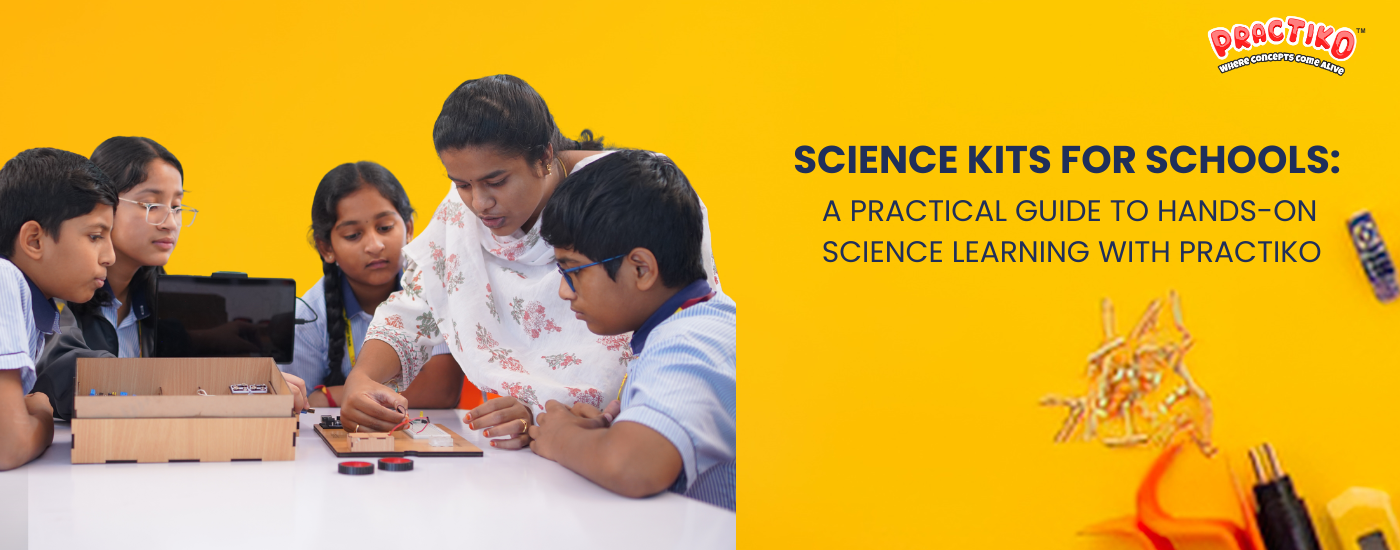
Science becomes easier to understand when students can experience it.
A textbook can explain a scientific principle, but when students can build something, perform an experiment, observe a result, and discuss what happened, the concept can become much more meaningful. This is the idea behind practical and experiential learning.For schools looking to introduce more hands-on learning into their classrooms, Science Kits for Schools can provide teachers with ready-to-use resources for exploring scientific concepts.
Practiko takes this approach further by combining activity kits with instructional booklets, video tutorials, app access, assessments, teacher training, and implementation support. Its broader learning solution includes 600+ hands-on activities across Science, Math, Robotics & Engineering.
The aim is not simply to give students more activities. It is to help them move from listening and memorising towards exploring, observing, participating, and understanding.
Science Kits for Schools are educational resources that provide materials and activities that help students explore scientific concepts through practical experiences.Instead of learning a concept only through a textbook or explanation, students can use the materials to investigate how something works.
For example, a lesson about motion can become an activity where students observe movement and forces. A lesson about light can involve shadows, reflections, mirrors, or lenses.The purpose of Science Educational Kits is therefore to connect classroom theory with practical observation.
Practiko’s science offering is designed around this approach. Its brochure describes its science activities as helping make science easier to teach and exciting to explore, with 150+ Science Kits available as part of its wider activity-based learning solution.
Students do not all learn in the same way.Some students understand a concept quickly through an explanation. Others understand it better when they can see it or work with it.This is why School Science Kits can be useful in modern classrooms.
Practical learning can give students opportunities to:
Observe scientific phenomena
Ask questions
Make predictions
Perform experiments
Record observations
Discuss results
Apply concepts
Learn from mistakes
According to the Practiko brochure, traditional classroom challenges can include maintaining student attention, explaining abstract concepts, limited participation, and concepts being forgotten after class. Practiko’s approach is designed to address these challenges by helping teachers teach concepts practically and increase participation and retention.
Teachers are central to practical learning.However, preparing materials for every activity can take considerable time. Teachers may have to find components, prepare instructions, organise students, and determine how to assess the activity.
Science Kits for Teachers can simplify this process by bringing relevant resources together.Practiko’s kits include materials and activities, while its Science & Math solution also provides booklets containing examples, instructions, and assessments. The brochure also highlights concept video tutorials and personalised app access.
This gives teachers several resources to support a practical lesson instead of relying only on a textbook.Practiko also provides virtual teacher training and implementation support. Its stated approach is to support teachers from onboarding through classroom implementation.
Science Experiment Kits for Schools are designed to help students investigate scientific concepts by performing activities themselves.
An effective experiment can follow a simple process:
Question → Prediction → Experiment → Observation → Discussion → Conclusion
For example, a teacher teaching about light can ask students what will happen when light interacts with different surfaces.Students can make predictions, conduct an activity, observe the outcome, and then discuss the reason behind it.
Practiko’s science activities include topics such as light, sound, perception, motion, matter, density, circular forces, shadows, reflections, and reactions.This gives teachers different ways to turn abstract concepts into practical learning experiences.
Practiko’s approach goes beyond supplying individual materials.
Its broader classroom solution combines:
Activity kits
Hands-on activities
Instructional booklets
Examples and instructions
Assessments
Video tutorials
App access
Curriculum development
Curriculum customisation
Design thinking
In-house R&D
Teacher training
Implementation support
The brochure describes the curriculum as developed by experts and designed to align with school syllabi and learning goals. It also lists CBSE, ICSE, Cambridge, and State Board alignment, along with 150+ Science Kits and 150+ Math Kits.
This means Practiko is positioned not simply as a kit provider but as a broader experiential learning solution for schools.
How Practiko Helps Teachers Make Science More Practical
One of the main challenges of practical teaching is having the right resources at the right time.Practiko’s approach is designed around the idea that teachers need tools, resources, and confidence to make lessons engaging and impactful. Its brochure highlights four areas:
- Making learning tangible with kits
- Demonstrating concepts visually through video tutorials
- Supporting teacher preparation with appropriate tools
- Improving student participation and knowledge retention
This makes Science Teaching Kits useful not only for the students but also for the teacher conducting the lesson.
Science covers a wide range of concepts, and practical activities can help students understand those concepts from different perspectives.
Depending on the grade and activity, students can explore areas such as:
Motion
Matter
Density
Forces
Light
Sound
Perception
Shadows
Reflections
Materials
Maps
Practiko’s Science Kits include examples such as Motion to Matter, which covers energy, motion, matter, density, and circular forces, and Light, Sound & Perception, which explores how light and sound influence the way we understand the world.
Other Practiko science activities cover foundational topics including maps, magnetism, friction, shadows, everyday materials, reflections, mirrors, and lenses.
Science Kits for Students: Learning by Doing
Students often remember something better when they actively participate in the learning process.
Science Kits for Students can encourage students to move through a simple cycle:
- Observe.
Ask a question.
Make a prediction.
Build or experiment.
Observe the result.
Discuss what happened.
Improve their understanding.
This is closely connected to Practiko’s classroom philosophy.The brochure describes a shift from a regular classroom model of listening, memorising, and theory towards a Practiko classroom where students explore, observe, participate, understand, and experience concepts.
Schools in India have different curricula, grade levels, infrastructure, and teaching requirements.When evaluating Science Kits in India, schools should therefore consider more than the number of components included in a kit.
Important factors include:
Curriculum alignment
Grade suitability
Activity variety
Quality of materials
Ease of classroom implementation
Teacher instructions
Assessments
Digital resources
Teacher training
Ongoing support
Practiko’s brochure states that its solutions are designed for grade-wise and subject-wise adoption in schools. It also reports 150+ partner schools across 10+ states in India, 1,000+ teachers, and 1 lakh+ students impacted.
For schools, curriculum alignment is an important consideration when selecting practical learning resources.Practiko describes its curriculum as being developed by experts and designed to align with school syllabi and learning goals. Its brochure specifically mentions CBSE, ICSE, Cambridge, and State Board requirements.
This approach can help schools introduce practical activities without treating them as completely separate from classroom learning.A teacher can first explain the curriculum concept and then use a practical activity to help students explore it.
Science Kits for CBSE Schools can be used to complement classroom teaching by providing practical experiences around concepts students are already studying.
For example:
Step 1: Introduce the scientific concept.
Step 2: Ask students a question related to the concept.
Step 3: Conduct a practical activity.
Step 4: Ask students to observe and record the result.
Step 5: Discuss why the result occurred.
Step 6: Connect the activity back to the curriculum.
This approach helps students see the relationship between theory and application.Practiko’s curriculum approach includes curriculum customisation and alignment with CBSE and other school boards, according to its brochure.
A key feature of Practiko’s approach is that classroom resources are brought together rather than requiring teachers to source every material separately.
For its Science & Math activities, the brochure highlights:
Quality tools and materials
Activities
Consumables
TLMs
Activity booklets
Examples
Instructions
Assessments
Concept video tutorials
Personalised app access
The brochure describes the kits as designed for easy classroom implementation and meaningful learning, with everything needed for the listed classroom activities included in the box.
Providing the kit is only one part of successful implementation.Teachers may also need help understanding the activities, accessing digital resources, or integrating practical learning into classroom sessions.
Practiko provides virtual teacher onboarding and implementation training. It also states that its customer support covers product support, app access, digital content, kit usage, and implementation queries.This support can be useful for schools that want to introduce hands-on learning consistently rather than using practical activities only occasionally.
The value of Science Activity Kits comes from what students learn through the activity.A classroom activity should not simply ask students to assemble something. It should encourage them to understand a concept.
For example, an activity involving shadows can help students explore how light behaves.An activity involving forces can help students investigate how different forces affect movement.
An activity involving materials can help students compare properties and think about real-world applications.Practiko’s science activities are built around specific concepts and grade levels, with examples ranging from foundational science to topics involving motion, matter, light, sound, forces, and materials.
Practical learning can also be extended into larger projects.
Science Project Kits can be useful for:
Science exhibitions
Classroom projects
Group activities
Science clubs
Innovation activities
Demonstrations
Practical assignments
Teachers can use projects to encourage students to apply concepts rather than simply reproduce information.The project can begin with a question and end with students presenting what they discovered.
Science Kits for Class 6 to 10
When selecting Science Kits for Class 6 to 10, schools should look for activities that match the complexity of the concepts students are expected to learn.Students at these levels can gradually move beyond simply following instructions.
They can be encouraged to:
Make predictions
Conduct investigations
Record observations
Compare results
Explain outcomes
Identify problems
Develop solutions
Present their findings
The Practiko brochure provides grade-specific science examples, including Grade 7 activities around light, shadows, reflections, mirrors, and lenses, and Grade 8 and Grade 9 activities covering light, sound, perception, energy, motion, matter, density, and circular forces.
Hands-on Science Kits work particularly well with experiential learning because students interact directly with the materials.Practiko’s broader classroom model is based on this principle.
Its brochure describes the movement from passive learning towards active exploration, where students listen, explore, observe, participate, understand, and experience.The objective is to make concepts tangible.
When students can interact with a concept, teachers can also ask more meaningful questions about what they observed and why it happened.
What Are the Benefits of Practiko Science Kits?
Practiko’s brochure identifies several intended classroom outcomes.
Higher student engagement
Students actively participate in lessons rather than only listening.
Better understanding
Practical activities can help make concepts easier to grasp and apply.
Stronger retention
The brochure highlights learning that extends beyond examinations.
Increased confidence
Students get opportunities to share ideas and participate.
Greater curiosity
Students are encouraged to ask questions and explore.
Teacher support
Teachers receive resources, training, and implementation assistance.
These elements are part of Practiko’s stated approach to creating classrooms where concepts become experiences.
Practiko’s brochure presents its solution as grade-wise and subject-wise, designed for adoption in schools.
Its reported school network includes:
- 150+ partner schools
- 10+ states in India
- 1,000+ teachers
- 1 lakh+ students impacted
The brochure also identifies areas such as strengthening STEM education, enhancing teacher effectiveness, improving student retention, aligning with the NEP 2020 vision, and creating future-ready classrooms.
The company describes itself as a BITS-Pilani alumni initiative and presents its solution as NEP-aligned.
Before choosing Science Kits, school leaders can ask a few practical questions:
Does the kit match our curriculum?
Is it appropriate for the students’ grade level?
What concepts and subjects does it cover?
Are the activities genuinely hands-on?
Are instructions provided for teachers?
Are assessments included?
Is digital content available?
Can teachers receive training?
Is implementation support available?
Can the materials be reused?
These questions help schools evaluate a kit based on classroom usefulness rather than simply the number of items inside the box.
The Practiko Classroom: Where Concepts Come Alive
Practiko’s central classroom idea is that students learn best by doing.Its model contrasts passive learning with active learning:
Regular classroom: Listen → Memorise → Theory
Practiko classroom: Explore → Observe → Participate → Understand → Experience
The brochure describes the intended result as moving students from passive learners to active explorers, with higher engagement, stronger retention, improved confidence, better understanding, and increased curiosity.This philosophy is reflected in Practiko’s broader range of Science, Math, Robotics & Engineering activities.
Science learning becomes more meaningful when students can experience concepts instead of only reading about them.Science Kits for Schools provide a practical way to bring experiments, activities, observation, and exploration into the classroom.For teachers, Science Kits for Teachers can make practical lessons easier to organise by providing structured materials and resources.
Practiko builds on this idea through a broader experiential learning solution that combines hands-on activity kits, booklets, video tutorials, app access, assessments, curriculum development, teacher training, and implementation support.
With 150+ Science Kits and a wider portfolio of 600+ hands-on learning activities, Practiko’s approach is focused on helping teachers make concepts tangible and encouraging students to become active explorers.
The ultimate purpose of practical science learning is simple:
Students should not only hear about science. They should have opportunities to explore it, test it, understand it, and experience it.That is the idea behind the Practiko Classroom — where concepts come alive.
Frequently Asked Questions
What are Science Kits for Schools?
Science Kits for Schools are educational resources containing materials and activities that help students explore scientific concepts through practical learning and experiments.
How do Science Kits for Teachers help educators?
Science Kits for Teachers provide organised materials and activities that can help teachers conduct practical lessons more efficiently. Practiko additionally provides activity booklets, video tutorials, app access, assessments, and teacher training.
What does Practiko provide to schools?
Practiko provides a broader experiential learning solution that includes activity kits, hands-on activities, digital content, instructional resources, assessments, curriculum development, teacher training, and implementation support.
How many Science Kits does Practiko offer?
The Practiko brochure lists 150+ Science Kits as part of its activity-based learning solution. Its overall offering includes 600+ hands-on learning activities across Science, Math, Robotics & Engineering.
Are Practiko kits suitable for CBSE schools?
Practiko’s brochure states that its curriculum approach aligns with CBSE, ICSE, Cambridge, and State Board requirements.
What subjects are covered by Practiko?
Practiko’s broader offering covers Science, Math, Robotics, and Engineering. Its Engineering & Robotics areas include mechanics, mechatronics, artificial intelligence, hydraulics, renewable energy, IoT/automation, electrical science, structural engineering, kinematics, and circuit simulations.
Does Practiko provide teacher training?
Yes. Practiko provides virtual teacher onboarding and implementation training to help teachers conduct activity-based classroom sessions using its kits.
Are Practiko kits reusable?
The brochure identifies Practiko’s DIY kits as eco-friendly and reusable.

Empowering schools, Teachers & Students with hands-on learning solutions that build curiosity, thinking and real understanding.
- Contact: +91 8374728844
- Monday – Friday: 9:00-20:00
- Saturday: 11:00 – 15:00
- Email: care@cognospace.in
Shop
- All Kits
- Math Kits
- Science Kits
- Robotics & Engg.
- STEM Models
- DIY Kits
For Schools
- Bulk Bundles
- School Solutions
- Request Quote
For Teachers
- By Grade
- By Subject
- Teaching Resources
For Parents
- By Grade
- By Subject
- Learning Resources
Company
Copyright © 2026, Practiko Powered by CognoSpace


