HomeUncategorizedRobotics, Engineering & AI Kits: Making STEM Learning Practical with Practiko
Sep 8, 2026
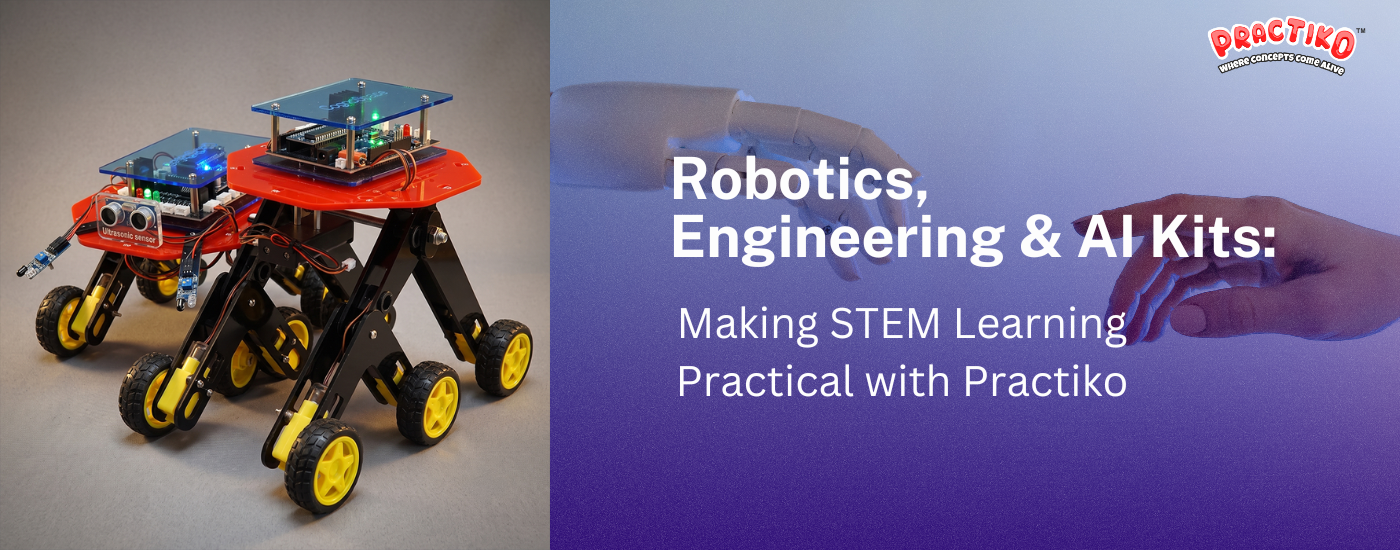
A student may be able to explain what a robot is or define artificial intelligence from a textbook. But ask that same student to build something, test it, find out why it isn’t working, and make it better, and suddenly the learning becomes much more meaningful.
This is the value of hands-on STEM education.
Robotics, engineering, and AI kits give students an opportunity to move beyond simply reading about concepts. They can build models, work with components, test different ideas, make mistakes, and learn how to improve their designs.
For schools looking to bring more practical learning into the classroom, Practiko offers activity-based learning resources covering Science, Mathematics, Robotics, Engineering, and AI. Its approach is built around a simple idea: students understand concepts better when they get an opportunity to experience them.
STEM concepts can sometimes feel difficult when students only encounter them through textbooks or classroom explanations.Take sensors, for example. A student can learn the definition of a sensor, but using one in an activity gives them a completely different understanding. The same applies to engineering. Building a structure and seeing what happens when it fails can teach students about stability and design much more effectively than memorising definitions.
Hands-on activities can give students opportunities to:
- Build and test simple mechanisms
- Explore basic robotics concepts
- Understand engineering principles
- Work with different components
- Develop logical thinking
- Solve problems through design
- Experiment with different solutions
- Work as a team
- Connect classroom concepts with real-world applications
The purpose of a robotics kit isn’t simply to help students build a robot. More importantly, it should encourage them to ask questions such as Why did this work? Why didn’t it work? What can I change?
That process is where much of the learning happens.
What Can Students Learn from Robotics Kits?
Robotics can introduce students to concepts that might otherwise seem abstract.With robotics kits for schools, students can work with components and activities that demonstrate movement, control, sensing, mechanisms, and problem-solving.
Imagine a classroom activity where students are asked to build a simple moving mechanism. Their first attempt might not work. Instead of simply giving them the correct answer, the teacher can encourage them to look at the design, identify the problem, make a change, and test it again.Students learn that getting something wrong is not necessarily a failure. It can be part of the process of finding a better solution.
Well-designed robotics education kits can help students develop:
- Logical reasoning
- Problem-solving skills
- Design thinking
- Computational thinking
- Creativity
- Practical experimentation
- Teamwork
- Confidence in trying new ideas
This makes robotics useful beyond a dedicated robotics class. It can also become part of STEM activities, classroom projects, and interdisciplinary learning.
Engineering Learning Through Hands-On Activities
Engineering is often associated with complicated machines, buildings, or advanced technology. But the basic idea behind engineering is much simpler: identify a problem and find a way to solve it.This is why engineering learning kits can be useful in schools.
A teacher could ask students to build a structure that can hold a certain amount of weight. Students have to think about the materials they are using, the shape of the structure, its stability, and how the different parts are connected.If the structure collapses, the activity doesn’t have to end there.
Instead, students can ask:
What caused it to fail?
Which part needs to change?
Can we make the structure stronger?
What happens if we use a different design?
These questions encourage students to think like engineers.Engineering kits for students can therefore turn engineering from something students read about into something they can explore with their own hands.
Artificial intelligence is becoming part of everyday life, from recommendation systems to voice assistants and automated technologies.For students, however, learning about AI shouldn’t stop at knowing what the term means.
Age-appropriate AI learning kits and activities can introduce students to ideas such as intelligent systems, sensors, automation, data, decision-making, and problem-solving.AI also becomes more interesting when students can see how it connects with other technologies.
For example:
Engineering → Build the physical system
Robotics → Add movement and control
AI → Add intelligent decision-makingWhen these areas come together, students can begin to understand that modern technologies don’t always work in isolation.This is one reason AI robotics kits can be useful for project-based STEM learning. Students can gradually move from following instructions to experimenting with their own ideas.
STEM Robotics Kits for Activity-Based Learning
One of the strengths of STEM learning is that different subjects can come together in a single activity.
A project involving a simple robotic or engineering model might require students to use:
- Mathematics to measure distances and dimensions
- Science to understand forces and motion
- Engineering to design and build
- Technology to work with components
- Robotics to introduce movement and control
- AI to explore intelligent decision-making
This interdisciplinary approach can help students understand that the subjects they study in school are connected to one another.
Instead of learning Mathematics, Science, Technology, and Engineering as completely separate areas, students can see how these concepts work together to solve real problems.
Hands-on learning is valuable for students, but teachers also need the right support to use it effectively.A classroom kit should not leave a teacher wondering what activity to conduct, what materials are required, or how the concept should be explained.This is where structured educational robotics kits can help.
Practiko provides activity-based learning resources designed to make practical classroom learning easier to implement. Its offering includes 600+ hands-on learning activities across Science, Math, Robotics, and Engineering, along with activity booklets, concept video tutorials, app access, and classroom materials.The Practiko model also includes teacher support. Its implementation programme provides virtual teacher training and onboarding to help teachers confidently conduct activity-based classroom sessions.This means the teacher remains at the centre of the learning process, while the kits and supporting resources make it easier to bring practical activities into regular lessons.
Practiko is built around the idea that students learn better when they can see, touch, explore, and experiment with a concept.The Practiko classroom approach moves students from simply listening and memorising towards exploring, observing, and participating.
Its learning resources include:
- Hands-on activity kits
- Activity booklets
- Concept video tutorials
- App access
- Science and Mathematics activities
- Engineering and Robotics modules
- Digital learning resources
- Teacher training and implementation support
The brochure also highlights Practiko’s reach across 150+ partner schools, 10+ states in India, 1,000+ teachers, and 1 lakh+ students impacted.For schools, this can make it easier to introduce practical learning without having to develop every activity and supporting resource independently.
Practiko’s Engineering & Robotics learning areas go beyond basic robot building.
Students can explore topics including:
- Mechatronics
- IoT and Automation
- Artificial Intelligence
- Hydraulics
- Renewable Energy
- Mechanics
- Structural Engineering
- Electrical Science
- Kinematics
- Circuit Simulations
- Sci-Tech Toys
For example, Mechatronics activities bring together mechanics, electronics, and automation. IoT and Automation introduce students to connected devices and smart technologies, while Renewable Energy activities allow students to explore energy from sunlight, wind, and water.
This variety gives schools the flexibility to expose students to different areas of STEM rather than limiting their practical learning to one subject
There is a difference between knowing an answer and understanding how to arrive at it.When students build something themselves, they have to make decisions. Sometimes those decisions work. Sometimes they don’t.
They may need to discuss the problem with their classmates, try another approach, and test the result again.These experiences can help students develop:
- Critical thinking
- Problem-solving
- Creativity
- Communication
- Collaboration
- Independent experimentation
- The ability to learn from mistakes
Hands-on robotics kits can create similar experiences. Instead of simply learning that a mechanism works, students can actually see what happens when they change its design.
That makes the learning experience more active and memorable.
Practiko’s approach is focused on making learning by doing a part of everyday classroom education.
Its resources can support activities related to:
- Robotics
- Engineering
- Artificial Intelligence
- Science
- Mathematics
- STEM projects
- Model building
- Problem-solving
The idea is not to replace traditional classroom teaching. Instead, practical activities can complement what students learn from their teachers and textbooks.
Practiko’s brochure describes its curriculum as hands-on, activity-based, developed by experts, and adaptable to different school boards and learning requirements. It also highlights curriculum areas including CBSE, ICSE, Cambridge, and State Boards.
This allows schools to introduce practical learning while keeping it connected to their existing curriculum.
Introducing STEM education doesn’t mean every school needs to build a highly technical laboratory immediately.Sometimes, practical learning can begin with simple classroom activities where students build, observe, test, and improve.
As students become more comfortable with this approach, teachers can gradually introduce more challenging projects.Practiko offers grade-wise and subject-wise learning solutions and currently highlights 150+ Science Kits, 150+ Math Kits, and 11 Engineering Modules in its brochure.
This kind of variety can help schools use hands-on activities across different grades and subjects.
Ultimately, the value of a STEM kit isn’t only the model that students take home or display in the classroom.The real value lies in what students learn while building it.
Before purchasing robotics kits for schools, it is worth looking beyond the number of components inside the box.
Schools should consider questions such as:
1. Are the activities appropriate for the students?
The activities should match the students’ age, grade level, and existing knowledge.
2. Can teachers use the kits comfortably?
A good kit should make classroom activities easier rather than add unnecessary complexity.
3. Do students get opportunities to experiment?
Students should have room to change designs, test ideas, and discover different solutions.
4. Can one kit support different concepts?
Kits that connect multiple STEM concepts can provide more opportunities for interdisciplinary learning.
5. Can students work together?
Group activities can help students develop communication and teamwork alongside technical skills.
6. Is teacher support available?
Training, instructions, digital content, and implementation support can make a significant difference when a school introduces hands-on learning across multiple classrooms.
Practiko provides virtual teacher training, onboarding, implementation assistance, and customer support for kit usage, digital content, app access, and related queries.
Conclusion
STEM education is not only about giving students more information. It is about helping them understand how things work and giving them opportunities to use what they know.Robotics, Engineering & AI kits can play an important role in making that possible.
Robotics kits allow students to explore movement and automation. Engineering kits give them opportunities to design, build, test, and improve. AI learning activities can introduce them to intelligent technologies and decision-making.Practiko brings these different experiences together through hands-on activity kits, structured learning resources, digital content, and teacher support.
With 600+ hands-on learning activities, along with its network of partner schools, teachers, and students, Practiko is designed to help schools make classroom learning more practical and engaging.The goal isn’t simply to build a robot or complete an activity.
It is to encourage students to ask questions, try ideas, make mistakes, solve problems, and learn by doing.
Frequently Asked Questions
What are Robotics, Engineering & AI Kits?
Robotics, Engineering & AI Kits are educational resources that help students explore robotics, engineering, artificial intelligence, and STEM concepts through practical activities and hands-on projects.
Who can use Robotics, Engineering & AI Kits in schools?
Practiko covers areas including Mechatronics, IoT/Automation, Artificial Intelligence, Hydraulics, Renewable Energy, Mechanics, Structural Engineering, Electrical Science, Kinematics, Circuit Simulations, and Sci-Tech Toys.
How do Robotics, Engineering & AI Kits help students learn engineering?
Robotics, Engineering & AI Kits give students opportunities to explore structures, forces, mechanisms, materials, design, robotics, and problem-solving through practical activities.
What can students learn with Robotics, Engineering & AI Kits?
With Robotics, Engineering & AI Kits, students can explore robotics, engineering principles, artificial intelligence, automation, sensors, data, decision-making, and other STEM concepts through age-appropriate activities.
Are Robotics, Engineering & AI Kits suitable for classroom learning?
Yes. Robotics, Engineering & AI Kits can be used for classroom demonstrations, group projects, STEM activities, and hands-on learning when the activities are appropriate for students’ age and curriculum.

Empowering schools, Teachers & Students with hands-on learning solutions that build curiosity, thinking and real understanding.
- Contact: +91 8374728844
- Monday – Friday: 9:00-20:00
- Saturday: 11:00 – 15:00
- Email: care@cognospace.in
Shop
- All Kits
- Math Kits
- Science Kits
- Robotics & Engg.
- STEM Models
- DIY Kits
For Schools
- Bulk Bundles
- School Solutions
- Request Quote
For Teachers
- By Grade
- By Subject
- Teaching Resources
For Parents
- By Grade
- By Subject
- Learning Resources
Company
Copyright © 2026, Practiko Powered by CognoSpace


