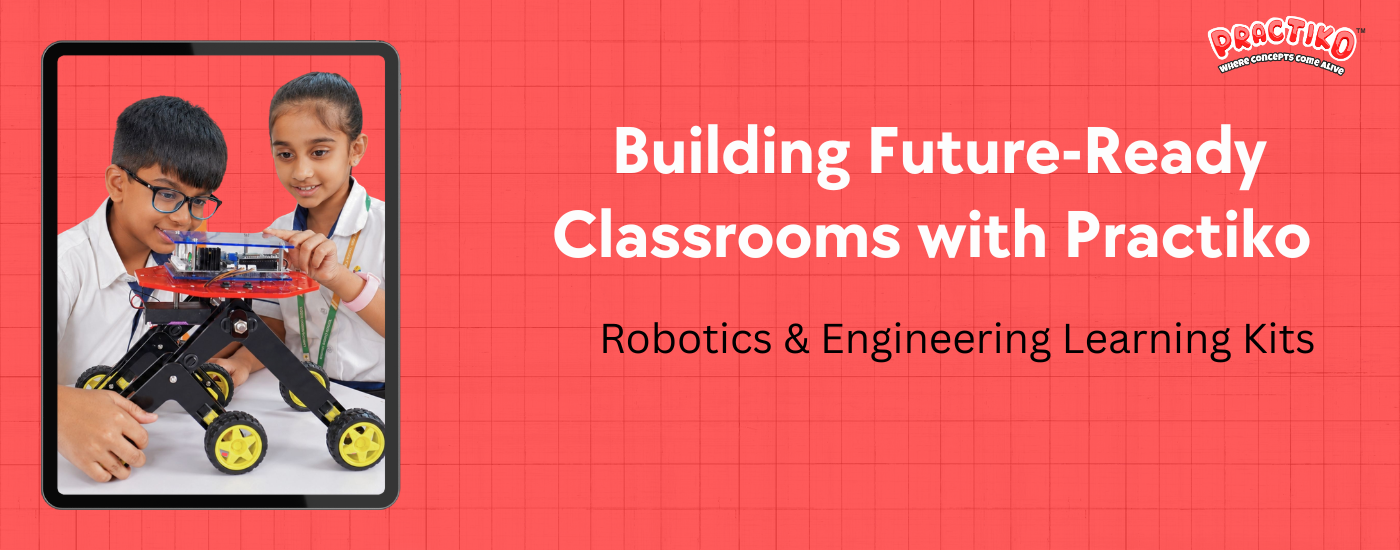
Making Engineering, Robotics, and STEM Concepts Practical Through Hands-On Classroom Learning
Students often understand a concept better when they can see it, touch it, experiment with it, and use it to solve a problem. This is especially true for subjects such as robotics and engineering, where understanding a concept theoretically is only one part of the learning process.
Practiko’s learning solution includes 600+ hands-on learning activities across Science, Math, Robotics & Engineering, with a focus on experiential learning for modern classrooms. The approach is designed to help teachers make lessons more engaging while encouraging students to participate actively.
Making Robotics and Engineering Easier to Explore
Robotics and engineering can introduce students to ideas that may initially seem difficult or abstract.When students work with physical components and practical activities, they can observe how different parts behave and how concepts connect with one another.
With Robotics & Engineering learning kits, a lesson can become an opportunity to investigate movement, mechanisms, electronics, automation, structures, and other engineering concepts.Instead of simply asking students to remember how something works, teachers can encourage them to explore the concept through an activity and discuss what they observe.This approach supports Practiko’s focus on making learning tangible through kits and demonstrating concepts visually through video tutorials.
Why Practical Engineering Learning Matters
Engineering is naturally connected to experimentation.A student may have an idea for a mechanism, but building it can reveal challenges that were not obvious when the idea existed only on paper.Perhaps the mechanism does not move as expected. Maybe a structure needs more support. Or a component needs to be positioned differently.These situations give students a chance to think, test, identify problems, and make improvements.
Robotics & Engineering learning kits can therefore support a classroom environment where mistakes become part of the learning process rather than something students should be afraid of.This kind of activity-based learning can also encourage students to ask more questions and become more curious about how things work.
Practiko Robotics Kits for Hands-On STEM Learning
Practiko robotics kits are designed to bring practical exploration into STEM learning.Robotics activities can introduce students to different areas of technology while helping them understand how individual components contribute to a larger system.
Students can explore mechanical and electronic components and work through structured activities supported by digital resources.The Practiko Engineering & Robotics offering covers 35 topics, including areas such as Mechanics, Mechatronics, IoT/Automation, Artificial Intelligence, Hydraulics, Renewable Energy, Structural Engineering, Electrical Science, Kinematics, and Circuit Simulations.
This range gives schools the flexibility to expose students to different aspects of engineering and technology.
Practiko Engineering Kits and Activity-Based Learning
Practiko engineering kits are designed to help students explore engineering through practical activities rather than keeping the subject entirely theoretical.Students can work with mechanical and electronic components while following activities that encourage observation and experimentation.
The aim is to create a learning experience where students can understand a concept and then see how that concept behaves in a practical setting.Practiko’s approach also includes hands-on STEM activities designed to encourage exploration of new domains and strengthen students’ understanding and analysis of classroom learning.
Exploring Mechatronics With Practiko
Mechatronics provides an interesting introduction to the connection between mechanical systems, electronics, and automation.Through suitable Robotics & Engineering learning kits, students can begin to understand how different systems work together to perform a task.
Practiko includes Mechatronics within its Engineering & Robotics learning areas, giving students an opportunity to explore this interdisciplinary field through practical learning.For learners, this can make engineering feel less like a collection of separate subjects and more like a connected system where mechanics, electronics, and technology interact.
Introducing IoT and Automation
Smart devices and automated systems are becoming part of everyday life.Introducing students to IoT and automation can help them understand some of the technologies behind these systems.
Practiko includes IoT/Automation among its Engineering & Robotics topics. Students can use practical activities as a starting point for understanding how connected devices and automated systems operate.Robotics & Engineering learning kits can help bring these ideas closer to students by connecting technical concepts with activities they can observe and interact with.
Artificial Intelligence in Engineering Education
Artificial Intelligence is another area that students are increasingly encountering in the world around them.
Practiko’s Engineering & Robotics offering includes Artificial Intelligence as one of its learning areas. The brochure describes AI activities around how intelligent systems learn, recognise patterns, and make decisions.Introducing such concepts through age-appropriate activities can help students begin developing an understanding of how intelligent systems work.
Learning Mechanics Through Hands-On Activities
Mechanics is an important foundation for engineering.Students can explore concepts involving forces, movement, gears, balance, and simple machines through practical activities.
Practiko includes Mechanics as part of its Engineering & Robotics offering. Its brochure highlights practical engineering applications involving forces, motion, and simple machines.When students can interact with mechanisms directly, they can begin to understand the relationship between different parts and the forces acting on them.
Exploring Electricity and Circuits
Electrical concepts can become much easier to discuss when students have the opportunity to work with components and observe circuits in action.Practiko includes Electrical Science and Circuit Simulations among its engineering learning areas. The topics include circuits, magnetism, electrical components, and electrical systems.Activities supported by Robotics & Engineering learning kits can give students a practical context for understanding these concepts.
Renewable Energy and Sustainable Engineering
Engineering education can also introduce students to sustainability.Practiko includes Renewable Energy as one of its engineering topics, with activities related to sunlight, wind, and water and their role in sustainable energy solutions.
Students can use these activities to explore how natural resources can be connected with engineering solutions.This gives learners an opportunity to think about technology not only in terms of what it can do, but also how it can contribute to sustainable development.
Structural Engineering and KinematicsEngineering also involves understanding how structures support loads and how mechanisms create and transform movement.
Practiko includes Structural Engineering and Kinematics among its Engineering & Robotics areas.Its activities include building and analysing strong, stable structures and exploring motion transformation through patterns and mechanisms.
These practical experiences can help students connect classroom concepts with real physical systems.What Makes Practiko Activity Kits Useful for Schools?
A successful hands-on learning programme needs more than individual components.Teachers need activities that can be incorporated into classroom sessions, while students need resources that guide them through the learning process.
Practiko activity kits combine learning materials with supporting resources. The brochure highlights activity kits, concept video tutorials, app access, instruction materials, and assessments as part of its learning solution.
For Engineering & Robotics, the kit includes electronic and mechanical components along with digital access to video tutorials, instruction manuals, and assessments.This combination helps connect the physical activity with the learning objective.
Designed for Collaborative Classroom Learning
Learning becomes more engaging when students have an opportunity to work together.Practiko’s Engineering & Robotics activities can be conducted in groups of 3–5 students, according to the brochure.
Each activity is designed around an approximate 45-minute duration, making the activities easier to incorporate into structured classroom sessions. Robotics & Engineering activities require a desktop/laptop with a Wi-Fi dongle or an Android tablet.Group activities can also encourage students to discuss ideas, divide responsibilities, and learn from one another.
Practiko STEM Learning Kits and Teacher Support
Teachers play a central role in making practical learning successful.Even the best Robotics & Engineering learning kits are most effective when teachers have the right resources and confidence to use them.
Practiko provides implementation support from onboarding through classroom sessions. Its brochure highlights virtual teacher training as well as 24/7 support for product usage, app access, digital content, and implementation queries.This support allows teachers to focus more on helping students explore and understand the activity.
From Passive Learning to Active Exploration
One of the central ideas behind the Practiko classroom is moving students from passive learning toward active participation.Students can listen, explore, observe, and participate rather than simply memorising information.
The Practiko approach describes this transition as moving from theory and passive learning toward experience and active learning.This is particularly valuable for engineering because students need opportunities to interact with systems and investigate how they work.
Robotics & Engineering learning kits provide a practical foundation for creating these experiences.
Skills Students Can Develop Through Robotics and Engineering
Practical activities can contribute to more than technical knowledge.While working on engineering challenges, students can develop:
- Problem-solving
- Critical thinking
- Creativity
- Collaboration
- Observation
- Logical reasoning
- Design thinking
- Communication
- Confidence
Practiko identifies higher engagement, stronger retention, improved confidence, better understanding, and increased curiosity among the impacts it aims to create in student learning.
When students build something themselves, they also have an opportunity to explain their thinking and learn from the outcome.
How Schools Can Use Robotics & Engineering Learning Kits
Schools can introduce practical engineering activities progressively.
Start With Foundations
Students can begin with simple activities involving movement, mechanisms, components, and basic engineering principles.
Introduce Integrated Activities
Once students understand the fundamentals, teachers can introduce activities that combine mechanical and electronic concepts.
Encourage Experimentation
Students can be encouraged to observe results and think about what might happen if they modify part of a system.
Explore New Technology
Schools can gradually introduce areas such as Mechatronics, IoT/Automation, Artificial Intelligence, Hydraulics, and Renewable Energy.
Encourage Creation
Practiko’s curriculum approach aims to move students beyond understanding and applying concepts toward creating, activating higher levels of Bloom’s taxonomy.
Through this progression, Robotics & Engineering learning kits can become part of a broader STEM learning journey.
Beyond Building Robots
Robotics is only one part of engineering education.
A strong programme can introduce students to mechanical systems, electronics, automation, structures, energy, motion, and emerging technologies.
Practiko’s range of Engineering & Robotics topics reflects this broader approach.
Students can explore:
This gives schools the opportunity to create varied learning experiences rather than repeating the same type of robotics activity.
Why Practiko Fits the Modern Classroom
Practiko describes its solution as a complete experiential learning solution for modern classrooms.
The brochure highlights NEP alignment, eco-friendly and reusable DIY kits, app access, expert-designed content, teacher support, and 600+ learning activities.
For schools, this means practical learning can be supported by a wider ecosystem rather than depending only on physical equipment.
Robotics & Engineering learning kits become one part of a classroom model that combines activities, resources, digital content, teacher preparation, and student participation.
Conclusion
The best engineering lessons do not have to end when the textbook closes.With the right activities, students can continue learning by building, observing, testing, discussing, and improving.
Robotics & Engineering learning kits can help schools create these opportunities by bringing practical engineering concepts into everyday classroom learning.Practiko combines these kits with digital resources, activity-based curriculum, teacher training, and classroom implementation support. Its Engineering & Robotics offering covers a broad range of areas, from Mechanics and Mechatronics to AI, IoT/Automation, Renewable Energy, Electrical Science, Structural Engineering, and Kinematics.
For schools looking to strengthen practical STEM education, Practiko Robotics & Engineering learning kits offer a structured way to help students move from simply understanding concepts to experiencing and applying them.Because when students get the opportunity to build, explore, and create, engineering becomes something they can experience—not just something they read about.
Frequently Asked Questions
What are Robotics & Engineering learning kits used for?
They can be used to help students explore engineering, robotics, mechanics, electronics, automation, and other STEM concepts through practical activities.
What Robotics and Engineering topics does Practiko cover?
Practiko covers areas including Mechatronics, IoT/Automation, Artificial Intelligence, Hydraulics, Renewable Energy, Mechanics, Structural Engineering, Electrical Science, Kinematics, Circuit Simulations, and Sci-Tech Toys.
What comes with Practiko Engineering & Robotics kits?
The Engineering & Robotics kits include electronic and mechanical components, supported by digital content such as video tutorials, instruction manuals, and assessments.
Can students work in groups?
Yes. Practiko’s Engineering & Robotics activities can be conducted in groups of 3–5 students. The brochure indicates an approximate 45-minute duration for each activity.
Does Practiko provide support to teachers?
Yes. Practiko provides virtual teacher training and ongoing support covering kit usage, digital content, app access, and implementation.
How do Practiko kits support experiential learning?
They give students opportunities to work with practical materials and activities while teachers use supporting resources such as tutorials, manuals, and assessments.

Empowering schools, Teachers & Students with hands-on learning solutions that build curiosity, thinking and real understanding.
- Contact: +91 8374728844
- Monday – Friday: 9:00-20:00
- Saturday: 11:00 – 15:00
- Email: care@cognospace.in
Shop
- All Kits
- Math Kits
- Science Kits
- Robotics & Engg.
- STEM Models
- DIY Kits
For Schools
- Bulk Bundles
- School Solutions
- Request Quote
For Teachers
- By Grade
- By Subject
- Teaching Resources
For Parents
- By Grade
- By Subject
- Learning Resources
Company
Copyright © 2026, Practiko Powered by CognoSpace


