HomeUncategorizedBest Science Kits in India: Practiko Science Project Kits & STEM Educational Kits for Schools
Aug 20, 2026
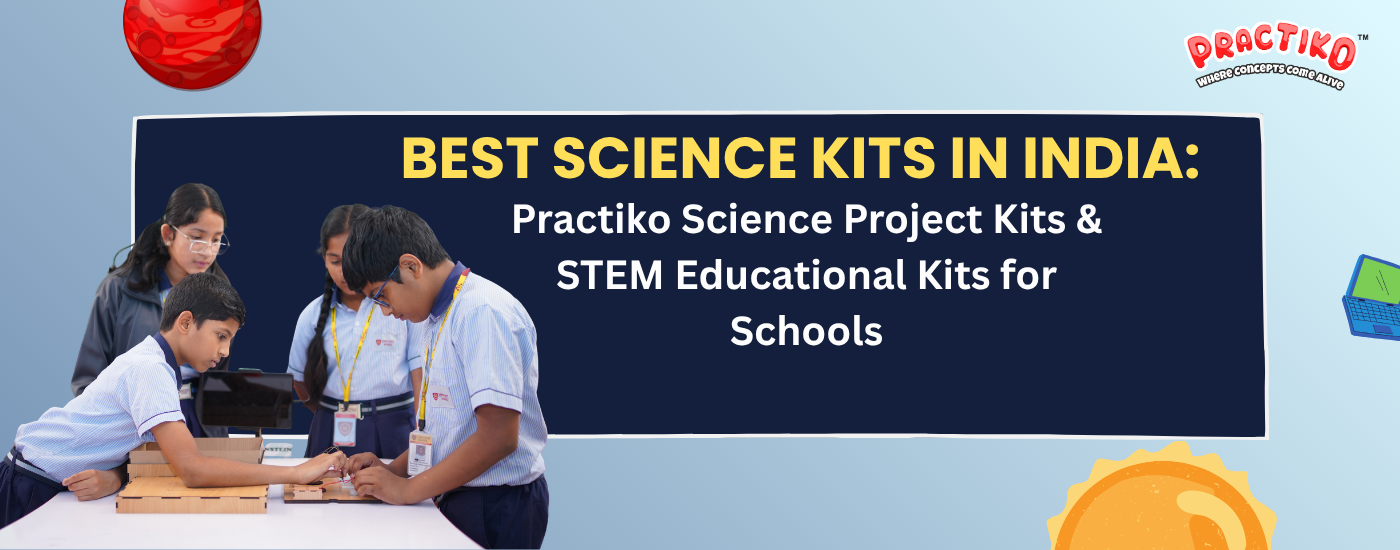
Indian schools are increasingly looking for ways to make Science more practical.A student may understand a definition from a textbook, but understanding becomes stronger when the student can build a circuit, test a force, observe sound or investigate how a scientific principle works.
This is why science kits in India are becoming an important resource for schools that want to introduce more hands-on learning.But choosing the right kit is not simply about finding a box filled with components.Schools need to consider curriculum relevance, grade level, classroom usability, teacher support, durability and the type of learning experience students will get.
Practiko provides hands-on Science and Math STEM DIY Kits for schools and students, with grade-wise options and learning resources designed to support practical exploration.
The Indian school environment includes different curricula, grade levels and classroom requirements.Schools following CBSE, ICSE and State Board curricula need learning resources that can fit into their existing teaching approach.
Well-designed science kits can help teachers turn theoretical concepts into activities.Instead of asking students to memorize a scientific principle, teachers can create opportunities for students to:
- Observe
- Build
- Test
- Measure
- Compare
- Discuss
- Solve problems
- Draw conclusions
This makes science project kits useful for regular classroom learning as well as project-based activities.
There are many educational kits available in the Indian market. However, the “best” science kits should be judged by learning value rather than the number of components inside the box.
Here are some factors schools should consider.
1. Curriculum Alignment
The activities should connect with concepts students are already expected to learn.
Practiko states that its kits are aligned with CBSE, ICSE and State Board curricula, making curriculum relevance an important part of its school-learning approach.
2. Grade-Level Suitability
A Grade 3 activity should not have the same complexity as a Grade 9 activity.
Practiko organizes its learning solutions across grade bands from Grades 1–3 through Grades 8–9.
3. Hands-On Learning
Students should be doing something meaningful with the materials.
This is where science experiment kits become valuable. They allow students to explore a concept through direct observation.
4. Teacher-Friendly Implementation
Teachers should not have to spend hours figuring out how an activity works.
Instructional manuals, guided videos and assessment resources can make classroom implementation easier.
Practiko highlights comprehensive instructional manuals, guided video tutorials and assessments within its learning solution.
5. Practical Classroom Use
The kit should fit the realities of a school classroom.
A good science kit for schools should be organized, understandable and appropriate for repeated educational use.
Science project kits can be especially useful when schools conduct project-based activities, science exhibitions or practical demonstrations.Instead of searching for individual materials for every project, teachers can use a structured kit designed around a particular concept.
A science project kit box may include the materials, components and learning resources needed for a specific activity.The exact science project kit items depend on the project.For example, an electricity-focused kit may contain components for circuit-based activities, while another kit may focus on force, motion, light or sound.
The important factor is not simply how many science project kit items are included. It is whether those items help students understand the intended concept.
Science Experiment Kits for Students
Science experiment kits can turn a regular Science lesson into an activity-based session.
- A teacher explaining electricity can ask students to construct and observe a circuit.
- A lesson on force can become an investigation into movement.
- A lesson about light and sound can involve practical observation.
These activities help students connect classroom explanations with real-world examples.
For schools, science experiment kits can therefore work as teaching aids rather than simply being project materials.
STEM Kits and Science Learning
Modern Science education increasingly overlaps with technology, engineering and mathematics.This is where STEM kits become useful.
A student working on an engineering problem may need to understand Science, use mathematical reasoning, design a solution and test it.STEM educational kits can bring these elements together.For example, a school may use Science Kits for concept learning and then introduce Engineering or Robotics Kits for design and problem-solving activities.
Practiko’s product range extends beyond Science Kits into Engineering and Robotic Kits, including Mechatronics, IoT, Artificial Intelligence, Mechanics and Structural Engineering.
STEM Kits India: What Should Schools Look For?
When schools search for STEM kits India, they should look beyond the product photograph.
Consider:
- Grade suitability
- Curriculum connection
- Quality of materials
- Number of students supported
- Teacher instructions
- Activity duration
- Storage requirements
- Assessment support
- Training availability
- Bulk purchasing options
- After-sales support
A school may also want to consider whether a supplier can provide different learning categories from the same ecosystem.
Practiko, for example, offers Science, Math, Engineering and Robotic learning solutions, along with school-focused bulk pricing and teacher training support.
STEM Educational Kits for Different Learning Levels
Primary School
For younger students, STEM educational kits should focus on curiosity, observation, simple construction and basic scientific relationships.
Middle School
Students can move toward more structured experiments, measurement, investigation and problem-solving.
At this level, science project kits can support classroom projects and concept reinforcement.
Grades 8 and 9
Older students can explore more advanced concepts and connect Science with engineering and technology.
Practiko’s current Science Kit range includes products for Grade 8 and Grade 9, covering areas such as electricity, light, sound, force, motion and matter.
Teachers can use science project ideas to encourage students to investigate questions rather than simply reproduce models.Possible project themes include:
- Electricity and circuits
- Force and motion
- Light and sound
- Energy
- Mechanical systems
- Materials and matter
- Renewable energy
- Engineering design
- Simple automation
- Robotics
The right science project ideas should allow students to explain what they observed and why it happened.
What Can Students Learn From Science Project Kits?
The value of science project kits goes beyond completing an assignment.
Students can develop:
- Observation skills
- Logical reasoning
- Problem-solving
- Design thinking
- Collaboration
- Measurement skills
- Scientific communication
- Confidence in experimentation
When students build something themselves, they can also identify mistakes and understand how changing one variable can affect the outcome.
Practiko is built around hands-on STEM learning, with Science Kits and Math Kits designed to make concepts more practical and interactive. Its website also presents school solutions that include curriculum alignment, bulk pricing, teacher training support and classroom implementation.
Practiko Science Kits are organized by grade and subject, making it easier for schools to select learning resources according to their students’ needs.The current range includes hands-on Science Kits such as:
- Power of Electricity for Grade 8
- Light, Sound & Perception for Grade 8
- Laws and Forces in Action for Grade 9
- From Motion to Matter for Grade 9
These products are designed around specific concepts rather than presenting students with an unrelated collection of materials.For schools, this approach can make it easier to connect a physical activity with a lesson objective.
Science Kits vs Buying Individual Project Materials
Teachers often spend time collecting materials for classroom activities.Buying individual components may work for occasional projects, but it can become difficult when a school needs to conduct similar activities across multiple classes.
A structured science project kit box can simplify preparation by bringing relevant materials together.It can also help teachers maintain consistency between classrooms.However, schools should always evaluate the quality and educational purpose of the science project kit items before making a purchase.
How to Choose Science Kits for Your School
Before purchasing science kits, create a simple checklist.
Ask these questions:
Which grades will use the kits?
Choose activities that match students’ age and learning level.
Which concepts need practical reinforcement?
Start with topics where students benefit most from experimentation.
How many students will use each kit?
This determines the number of kits required and the overall school budget.
Does the kit support the curriculum?
Look for curriculum-relevant activities.
Does the teacher receive implementation support?
Guides, videos and training can make a major difference.
Can students use the kit independently or in groups?
This affects classroom planning.
Can the kits support repeated learning?
Schools should consider long-term classroom value rather than a one-time project.
Why Schools in India Are Moving Toward Hands-On STEM Learning
Students learn differently when they are allowed to participate in the learning process.Hands-on STEM kits can create opportunities for students to ask questions, test ideas and solve problems.
For Indian schools, this approach also fits the broader movement toward experiential and competency-based learning.The goal is not to replace textbooks or teachers.The goal is to give teachers additional tools to make difficult concepts easier to demonstrate.
The right learning resources can change how students experience Science.Instead of only reading about a concept, students can investigate it. Instead of memorizing a process, they can build it. Instead of simply completing a project, they can understand why it works.
That is the purpose of well-designed science kits, science project kits and STEM educational kits.For schools in India, the best approach is to choose kits based on grade level, curriculum relevance, practical classroom use and learning outcomes.
Practiko brings these elements together through grade-wise Science Kits, Math Kits and Engineering and Robotic Kits designed for hands-on learning.Whether a school is looking for science kits, science project kits, science experiment kits or broader STEM kits India solutions, the focus should remain the same: helping students move from simply knowing a concept to actually understanding how it works.

Empowering schools, Teachers & Students with hands-on learning solutions that build curiosity, thinking and real understanding.
- Contact: +91 8374728844
- Monday – Friday: 9:00-20:00
- Saturday: 11:00 – 15:00
- Email: care@cognospace.in
Shop
- All Kits
- Math Kits
- Science Kits
- Robotics & Engg.
- STEM Models
- DIY Kits
For Schools
- Bulk Bundles
- School Solutions
- Request Quote
For Teachers
- By Grade
- By Subject
- Teaching Resources
For Parents
- By Grade
- By Subject
- Learning Resources
Company
Copyright © 2026, Practiko Powered by CognoSpace


